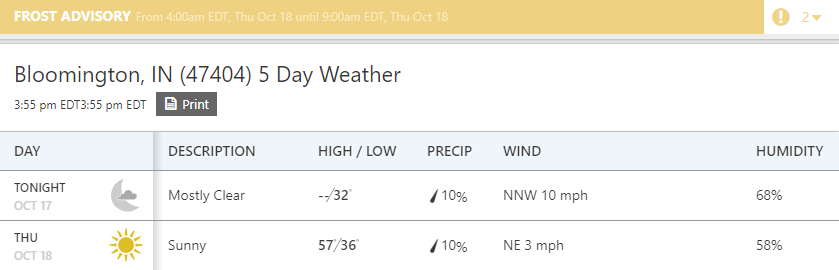
Rainy from now until Friday morning. We'll see a beautiful Saturday before rain returns for Sunday night. Things seem to change after November 8. The GFS is hinting at cold and snow.
Peak fall colors are happening now.
Get your best fall pictures today and tomorrow. Heavy rains come in for Wednesday and Thursday.
Analysis and thoughts.
Highs in the 50's and lows in the 40's the next three days. This pattern will stay for a while. Things look very interesting around November 3rd to November 6th. Will see what tomorrow's computer run says. Most people are saying that November will be warmer but I'm not quite sold on that idea yet.
Also, if you love taking pictures of fall colors then I would suggest taking your camera with you this weekend and all of next week. The leaves are quickly approaching their peak colors. I'll post more pictures when I have them.
Fall colors are nearing their peak
That wind storm over the weekend brought down a lot of leaves. I doubt we'll see the spectacular colors that we've seen in years past.
When is peak fall foliage in Bloomington Indiana?
Technically the correct answer is October 29th but this has been a strange year. I've seen trees that are completely bare and trees that have some color and trees that are completely green. Given this, I'm going to say that next weekend will be the peak for fall colors. I'll say between the 25th and 30th. Don't expect it to be as spectacular as in past years.
Tornado Research bullet points from the NWS Louisville Office.
A study published recently in npj Climate and Atmospheric Science, by Vittorio A. Gensini of Northern Illinois University and Harold E. Brooks of the National Severe Storms Laboratory, looked into the possibility that tornado frequencies are changing across the United States. Their findings include a decrease in the traditional "Tornado Alley" of the Great Plains and an increase in the Southeast's "Dixie Alley". This study generated a fair amount of buzz, so we thought we'd briefly list out a few of the more important points mentioned in the study:
- After removing non-meteorological factors, the annual frequency of U.S. tornadoes through the most reliable portions of the historical record has remained relatively constant.
- Detecting spatial shifts in tornado frequency is challenging. Tornadoes are short-lived and affect very small geographical areas. Also, tornado reporting procedures have varied dramatically over the years and from one region to another.
- The study used the Significant Tornado Parameter (STP) to account for tornado frequency. STP is designed to highlight the existence of atmospheric ingredients favoring large storms capable of producing EF2-EF5 tornadoes, like what is typically seen in the Great Plains.
- It should be noted that even if the atmosphere is supportive of tornadoes with the right winds, moisture, and instability, thunderstorms won't form without a strong enough trigger to spark them (like a cold front). The STP does not account for whether or not a trigger is present.
- However, STP values correspond with tornado reports closely enough such that STP is a suitable index to use. STP is especially useful in January, February, March, May, and December.
- The period analyzed in this study was from 1979 to 2017.
- A significant upward trend in tornado frequency was found in portions of the Southeast, Midwest, and Northeast.
- Both tornado reports and tornado environments indicate an increasing trend in portions of Mississippi, Alabama, Arkansas, Missouri, Illinois, Indiana, Tennessee, and Kentucky.
- It should be kept in mind that STP is designed to evaluate environments favorable for large storms typical of the Great Plains, and not necessarily small spin-ups that we see in regions farther east.
- Unfortunately, increases in tornado frequency in the American South juxtapose with a population that is especially vulnerable to tornadoes. The Southeast already represents a maximum in the occurrence of tornado casualties.
Keep in mind that this study was not associated with nor is it necessarily endorsed by NOAA or the National Weather Service. This information is presented here simply because of public interest.
It should be noted that this is just one study. Nevertheless, it is important for residents of the Ohio Valley and southeast United States to always be prepared for severe weather, including tornadoes. Right now, when the weather is quiet, is an excellent time to put together a tornado safety plan for your family. Have a survival kit and your plan in place well before severe weather strikes!
Tornado Research Paper in the NPJ
I thought Indiana was seeing fewer tornadoes but research shows otherwise.
Spatial trends in United States tornado frequency.
Subscribe to:
Posts (Atom)